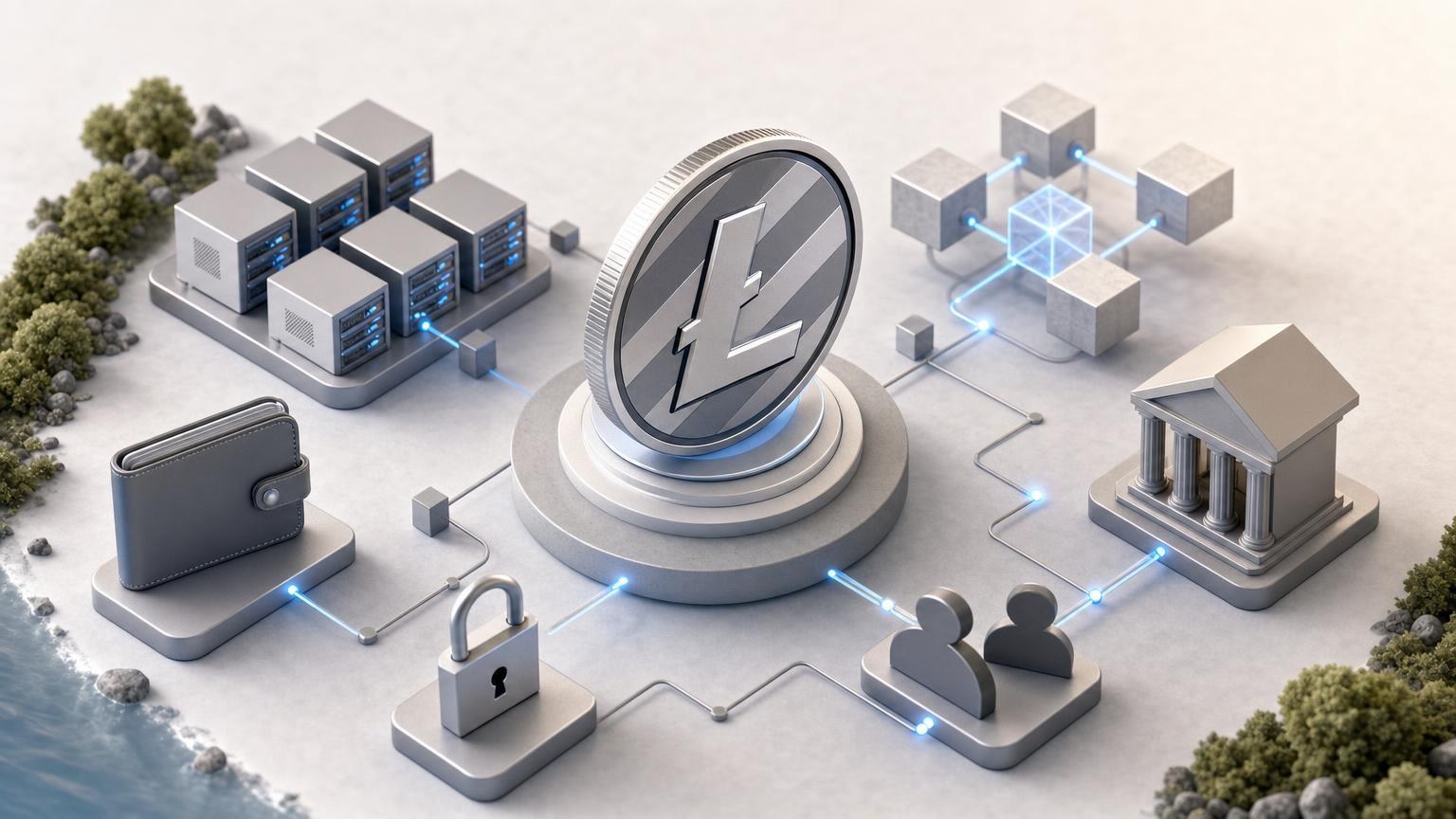
Litecoin is a peer-to-peer digital currency designed primarily for transferring value without a central operator. Its native asset, LTC, can be held in a compatible wallet, sent directly between addresses, used for payments where accepted, or exchanged for other supported assets. Litecoin shares much of Bitcoin’s architecture but uses Scrypt proof of work, targets a block roughly every 2.5 minutes and has a maximum supply of 84 million LTC. These parameters describe the protocol; they do not guarantee a particular transaction time, fee, exchange rate or level of merchant acceptance. [1]
Knowledge map and three reading routes
The subject can be reduced to seven connected nodes. Each answers a different practical question:
- Purpose: what Litecoin is intended to do.
- Asset and ledger: what LTC represents and where ownership records exist.
- Transactions: how value moves from one address to another.
- Consensus and mining: how the network orders and validates transactions without a central processor.
- Wallets and custody: how users control keys and interact with the network.
- Uses: where LTC may be practically useful.
- Limits and verification: what must be checked before sending, receiving or exchanging it.
| Reading route | Recommended sequence | Expected result |
|---|---|---|
| Understand Litecoin quickly | Purpose → asset and ledger → uses → limits | You can explain what LTC does, how it differs from a bank balance and why protocol speed is not the same as guaranteed settlement. |
| Prepare for a practical action | Wallets and custody → transactions → uses → verification | You can prepare an LTC transfer or exchange while checking the address, network, fees, availability and counterparty requirements. |
| Understand the technology | Asset and ledger → transactions → consensus and mining → issuance → MWEB | You can trace the path from a signed transaction to a mined block and distinguish the transparent main chain from optional MWEB functionality. |
The central relationship is straightforward: digital value → cryptographic authorization → network validation → practical transfer → operational risk → independent verification. Litecoin’s technology supplies the mechanism, but the user or service still has to select the correct network, protect private keys and decide how much confirmation is appropriate for the transaction.
Node 1: What Litecoin is designed to do
Litecoin is an open-source cryptocurrency network. There is no central institution that maintains every user’s account or unilaterally approves transfers. Participating nodes validate protocol rules, while miners use proof of work to propose blocks containing transactions. Litecoin Core is the project’s full-node software and source-code implementation. [1]
The network’s main function is value transfer. It can serve as payment infrastructure or as a settlement rail between compatible wallets and services. It is not a bank account, a payment guarantee or a general-purpose smart-contract platform comparable to networks built around extensive application execution. Ownership of LTC also does not create a claim on the Litecoin Foundation, miners or software developers.
| Concept | What it means for Litecoin | What it does not mean |
|---|---|---|
| LTC | The native unit recorded and transferred under Litecoin’s protocol rules | A share in a company or a guaranteed income-producing asset |
| Litecoin network | Nodes, miners, protocol rules and transaction history | A single website, wallet provider or exchange |
| Wallet | Software or hardware used to manage keys and create transactions | A container in which coins physically reside |
| Block confirmation | Evidence that a transaction has been included in the blockchain | An absolute promise that every recipient will treat it as finally settled |
| Exchange support | A service-specific ability to receive, send or convert LTC | Proof that every pair, network or direction is currently available |
Node 2: LTC, the ledger and the issuance model
LTC exists as entries governed by the Litecoin blockchain rather than as files stored inside a wallet. A wallet manages the cryptographic keys needed to authorize spending. A block explorer can display public main-chain transactions, but it does not hold funds or recover lost keys.
Litecoin uses a capped issuance model. The protocol targets a maximum of 84 million LTC, and the mining subsidy is scheduled to halve every 840,000 blocks. Blocks are targeted at approximately 2.5-minute intervals, so the halving schedule is based on block height rather than a fixed calendar date. Actual block arrival is probabilistic: two blocks may be found close together, while another may take longer than the target interval. [2]
This supply policy should not be confused with market scarcity or price stability. A fixed protocol ceiling does not guarantee demand, liquidity, purchasing power or future price performance. The market price of LTC can change sharply, and the rate quoted by a trading or exchange service may change between viewing an estimate and creating or completing an operation.
Technical depth: why wallet balances are not conventional accounts
Litecoin follows a transaction-output model related to Bitcoin’s design. A wallet identifies spendable outputs controlled by its keys, selects enough of them to fund a payment and usually creates a separate change output. Consequently, the amount visible in a wallet is an aggregation calculated from relevant spendable outputs, not a row in a central account database.
This model affects transaction size and fees. Spending several small outputs can require more transaction data than spending one larger output. The amount transferred is therefore not the only factor that may influence the network fee selected by a wallet.
Node 3: How an LTC transaction moves through the network
A standard transfer begins when a sender enters a Litecoin address, specifies an amount and approves the transaction in a wallet. The wallet selects inputs, creates outputs, applies a fee policy and signs the transaction with the necessary private keys. It then broadcasts the signed data to peers.
Nodes check whether the transaction follows consensus and relay policies. Miners can select valid transactions for inclusion in a candidate block. Once a block containing the transfer is accepted, the transaction receives its first confirmation. Additional blocks increase the amount of proof of work built on top of it.
- Preparation: obtain the destination address and confirm that the recipient expects LTC on the Litecoin network.
- Construction: the wallet chooses spendable inputs, destination output, change output and network fee.
- Authorization: the transaction is cryptographically signed.
- Broadcast: peers receive and validate the transaction.
- Block inclusion: a miner includes it in a valid block.
- Confirmation: subsequent blocks reduce the practical risk of transaction-history reorganization.
- Recipient crediting: a wallet or custodial service applies its own confirmation and compliance policy.
The 2.5-minute block target is not a guaranteed delivery time. A transfer may wait for block space, a wallet may choose an unsuitable fee, a service may require multiple confirmations, or a deposit may undergo additional review. The recipient’s crediting time can therefore be longer than the interval between blocks.
Blockchain transfers are also not equivalent to card payments. There is no standard chargeback mechanism that automatically reverses an accidental payment. If the sender uses an incompatible network, copies a fraudulent address or sends to a destination whose keys are unavailable, recovery may be difficult or impossible.
Confirmations are a risk decision, not a universal number
There is no single confirmation count suitable for every situation. A person accepting a small in-person payment may evaluate risk differently from a custodial platform processing a large deposit. Exchanges, payment processors and other recipients can change their thresholds in response to transaction value, network conditions, internal controls or compliance findings.
Before relying on an incoming payment, check the transaction identifier in a reputable Litecoin explorer, verify that the destination matches the intended address and review the recipient’s stated confirmation policy. A visible transaction should not be treated as proof that a custodial service has already credited the account.
Node 4: Scrypt proof of work, miners and nodes
Litecoin uses Scrypt proof of work. Miners repeatedly calculate hashes while searching for a block header that satisfies the network’s current target. A successful block can contain valid transactions and a coinbase transaction allocating the permitted block subsidy and collected transaction fees. Full nodes independently verify the result rather than trusting the miner’s claim. [2]
Mining and validation are related but distinct:
- Miners compete to propose blocks and commit computational work.
- Full nodes enforce the rules they run, reject invalid blocks and maintain their view of the blockchain.
- Wallets create transactions and manage keys; lightweight wallets may rely on external infrastructure instead of independently validating the full chain.
- Custodial services maintain internal account records and decide when an on-chain deposit can be credited or withdrawn.
Proof of work provides a mechanism for ordering transactions and making history costly to rewrite. It does not make every wallet, website or exchange trustworthy. Network consensus cannot prevent a user from disclosing a recovery phrase, installing malicious software or approving a transfer to a scammer.
Technical depth: protocol parameters worth knowing
Litecoin’s documented Scrypt proof-of-work implementation uses the parameters N=1024, r=1 and p=1 and produces a 256-bit output. These details matter to mining and software implementations but are not settings an ordinary sender chooses for each payment. [2]
Difficulty and mining conditions are dynamic. Hardware profitability depends on variables such as equipment cost, electricity, pool terms, network hash rate and the market value of rewards. None of these should be inferred from Litecoin’s block interval or supply cap alone.
Node 5: Wallets, custody and address compatibility
A Litecoin wallet’s most consequential function is key management. Whoever can use the relevant private key or recovery phrase can generally authorize spending. The choice between self-custody and custodial storage therefore changes both control and responsibility.
| Model | User controls keys | Main advantage | Main limitation |
|---|---|---|---|
| Self-custody software wallet | Usually yes | Direct transaction control | Device security and backups are the user’s responsibility |
| Hardware wallet | Usually yes | Keys can remain isolated from a general-purpose computer | Compatibility, firmware authenticity and recovery procedures still require verification |
| Full-node wallet | Usually yes | Independent blockchain validation and access to advanced functions | Requires storage, synchronization and maintenance |
| Custodial wallet or exchange balance | No | Simpler account-based interface | Withdrawals and access depend on the operator’s security, policies and compliance controls |
Litecoin has multiple address formats for different transaction capabilities, including main-chain and MWEB-related formats. An address that is valid at the protocol level may still be unsupported by a particular wallet or service. Litecoin documentation notes that prefixes help distinguish Litecoin addresses and that different formats can correspond to features such as SegWit or MWEB. [2]
Never infer network compatibility from a familiar-looking prefix, ticker symbol or copied label alone. Confirm all three elements with the recipient: the asset is LTC, the selected network is Litecoin, and the destination format is supported by the receiving system.
Wallet safety checklist
- Download wallet software only from the project or vendor’s verified distribution channel.
- Check the application name, publisher and digital signatures where available.
- Record the recovery phrase offline and keep it away from cameras, cloud notes, email and messaging apps.
- Do not enter a recovery phrase into a website opened from an advertisement or unsolicited message.
- Verify the full destination address on the signing device, not only its first and last characters.
- Use a small test transfer when dealing with a new wallet, service or address format.
- Confirm that the backup can restore the intended wallet before relying on it for significant value.
Node 6: What MWEB changes—and what it does not
MimbleWimble Extension Blocks, or MWEB, is an optional extension integrated into Litecoin through a soft-fork activation in May 2022. It allows supported users to move LTC into an extension-block environment with confidential transaction amounts and less directly visible address-balance information. Coins can move between the transparent main chain and MWEB through peg-in and peg-out operations. [3]
MWEB should not be described as guaranteed anonymity. It is optional, and activity at the boundary between the transparent chain and the extension block can expose timing, amounts or other contextual clues. Privacy also depends on wallet behavior, usage patterns, the size of the active anonymity set and information collected outside the blockchain.
Support is not universal. Some wallets, custodians and exchanges may accept ordinary Litecoin addresses but not MWEB deposits or withdrawals. Others may apply additional restrictions because rules and risk policies differ between countries and operators. Compatibility must be checked before sending; an MWEB-capable wallet does not prove that the recipient can process the same address type.
| Property | Transparent main chain | MWEB |
|---|---|---|
| Transaction visibility | Amounts and transaction relationships are generally publicly inspectable | Designed to conceal transferred amounts within the extension-block environment |
| Use | Default path for broad wallet and service compatibility | Optional path requiring explicit software support |
| Explorer analysis | Standard transfers can be followed through public records | Internal details are more limited, while peg-in and peg-out boundaries remain relevant |
| Operational check | Confirm Litecoin network and address support | Confirm both Litecoin and specific MWEB support |
Node 7: Practical uses of LTC
Litecoin’s architecture makes it most directly relevant to transferring a native digital asset. Whether that is useful depends on acceptance, liquidity, custody requirements and the legal framework applicable to the participants.
Direct wallet-to-wallet payments
Two parties can exchange an LTC address and transfer value without routing the blockchain transaction through a card network. This may be useful when both parties already use compatible wallets and agree on how to calculate the amount owed. The recipient still has to decide how many confirmations to wait for and how to handle exchange-rate volatility.
Merchant and invoice payments
A merchant can quote a price in LTC or convert a fiat-denominated price at checkout. This introduces several variables outside the protocol: quote expiration, refund handling, accounting, local tax treatment and the payment processor’s settlement rules. Litecoin confirms the blockchain transaction; it does not determine the commercial terms of the sale.
Transfers between personal wallets
A user may move LTC from a custodial account to a self-custody wallet, between two self-custody wallets, or back to a service that accepts deposits. These transfers can be part of a custody change rather than a purchase. Withdrawal fees, deposit requirements and supported address formats are set by the relevant service and must be checked at the time of the operation.
Exchanging LTC for another asset
LTC can be exchanged when a provider supports the requested direction and network. The quoted result can depend on market conditions, liquidity, service fees and compliance procedures. Availability should be verified before sending funds; a service listing LTC does not imply that every LTC pair, network option or transaction direction is open.
Mining participation
Specialized Scrypt mining equipment can participate in block production, usually through a pool or another mining arrangement. This is an operational activity rather than a passive feature of holding LTC. Equipment performance, electricity costs, network difficulty and pool conditions are dynamic, so mining should not be presented as guaranteed income. The Litecoin project notes that specialized Scrypt ASIC hardware has displaced ordinary consumer hardware as the efficient mining approach. [4]
Limits that shape every use case
Litecoin solves a narrower problem than many descriptions of cryptocurrency suggest. It supplies an open protocol for recording and transferring LTC, but it does not eliminate market, operational or regulatory constraints.
- Volatility: the fiat value of LTC can change before, during or after a transaction.
- Irreversibility: there is no network administrator who can routinely cancel a correctly signed transfer.
- Address and network risk: using an unsupported destination or incompatible network can result in loss or a complex recovery process.
- Custody risk: self-custody exposes the user to backup and key-management failures, while custodial storage introduces operator and access risk.
- Confirmation uncertainty: the target block interval is an average protocol parameter, not a completion deadline.
- Phishing: fake wallets, support accounts, browser extensions and address-substitution malware can bypass otherwise sound blockchain security.
- Service-specific rules: deposit crediting, withdrawals, fees and verification requirements are determined by each provider.
- Jurisdictional differences: tax, reporting, consumer-protection and cryptocurrency rules vary between countries and can change.
- Privacy limits: ordinary Litecoin activity is publicly observable, while MWEB provides optional confidentiality rather than absolute anonymity.
Procedure for verifying an LTC operation
A reliable check separates protocol-level facts from service-level conditions. The blockchain can show that a transaction was broadcast and included in a block, but only the receiving service can confirm whether the deposit format is supported, how many confirmations it requires and whether additional review applies.
| Stage | Question to answer | Where to verify |
|---|---|---|
| Asset | Is the recipient expecting LTC rather than another asset? | Recipient’s deposit or invoice screen |
| Network | Is the operation using the native Litecoin network? | Both sending and receiving interfaces |
| Address type | Does the recipient support this standard or MWEB address? | Recipient’s current documentation or support channel |
| Amount | Does it satisfy any current minimum, maximum or invoice requirement? | Live operation terms; do not rely on an old screenshot |
| Fee | What fee will the wallet or service apply now? | Final confirmation screen before signing |
| Compliance | Could the direction require identity, source-of-funds or other checks? | Provider’s current operation-specific requirements |
| Confirmation | How many confirmations does the recipient require? | Recipient policy and transaction status page |
| Completion | Was the exact destination credited? | Blockchain record plus the recipient’s account or wallet |
Final send checklist
- Confirm LTC and the native Litecoin network on both sides.
- Check whether the destination supports the chosen address type, especially for MWEB.
- Compare the entire address after pasting it.
- Review the amount, change output where visible and network fee.
- Check current minimums, limits and confirmation requirements instead of relying on historical values.
- Consider a small test transaction for a new destination.
- Save the transaction identifier without exposing private keys or recovery data.
- Do not send additional funds merely because an unsolicited “support agent” claims the first transfer is locked.
Applying the map to an LTC exchange
For an exchange operation, follow the map in order: identify LTC as the asset, confirm the Litecoin network and supported address format, review the live quote and terms, then verify the resulting transaction on-chain. The exchange service supports LTC among its listed assets, but that fact alone does not establish that a particular pair, network or direction is available at the moment you need it.
Before creating an operation, check the currently available LTC exchange directions. Review the displayed receiving asset, network, amount conditions and destination details before transferring funds. Verification requirements can depend on the selected direction and the outcome of compliance checks, so they should be confirmed for the specific operation rather than assumed from a previous exchange.
The useful conclusion is narrower than a price forecast: Litecoin provides a proof-of-work network focused on transferring LTC, with relatively frequent target blocks and optional MWEB confidentiality. Safe use depends less on memorizing protocol statistics than on matching the asset, network, address type, custody model and recipient policy for every transaction.